

From a graphic t-shirt to intricately patterned home textiles, the art of textile printing transforms blank fabric into a vibrant canvas. But behind every sharp, durable, and soft-to-the-touch print lies a sophisticated chemical support system. These unsung heroes are the printing auxiliaries. This ultimate guide will take you from blank fabric to vibrant design, unlocking the chemistry behind flawless textile printing and explaining the crucial roles of these essential chemicals. For those looking to master their craft, understanding these components is the first step. Explore our complete range of textile chemicals to find the perfect ingredients for your formula.
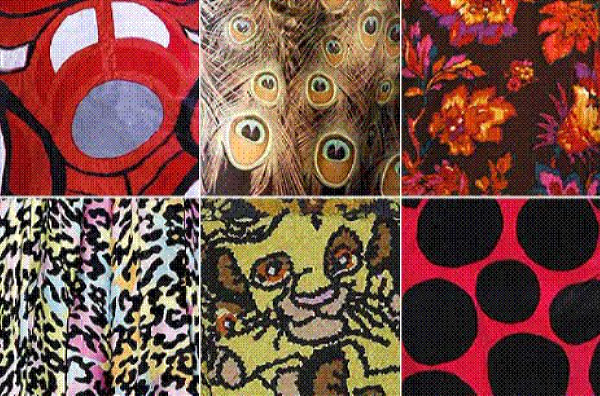
What are printing auxiliaries? In the simplest terms, they are specialized chemical agents added to a colorant (like a pigment) to create a usable print paste and to ensure the final print has the desired properties. They are the backbone of a successful textile printing operation.
Think of a pigment as the color, but it has no natural ability to stick to fabric or flow correctly through a screen. Printing auxiliaries create the perfect vehicle for the pigment. They are the support system that carries the color, bonds it to the fabric, and gives it the right consistency for application.
The essential functions of these auxiliaries can be broken down into four key areas:
What is the most important printing auxiliary for pigment printing? Without a doubt, it is the binder. In pigment printing, binders are the glue that holds everything together.
Pigments are insoluble particles with no natural affinity for textile fibers. A binder is a polymer resin that, when mixed with the pigment and printed onto the fabric, forms a thin, transparent film. During the curing (heating) process, this film permanently locks the pigment particles onto the fiber surface.
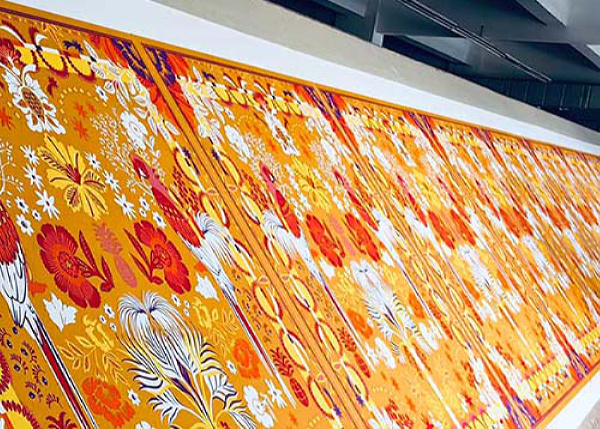
The choice of binder is a critical balancing act. A good binder must provide excellent fastness (wash and rub resistance) without making the print feel overly stiff or "plasticky." The goal is always to achieve great durability while maintaining a soft hand feel.
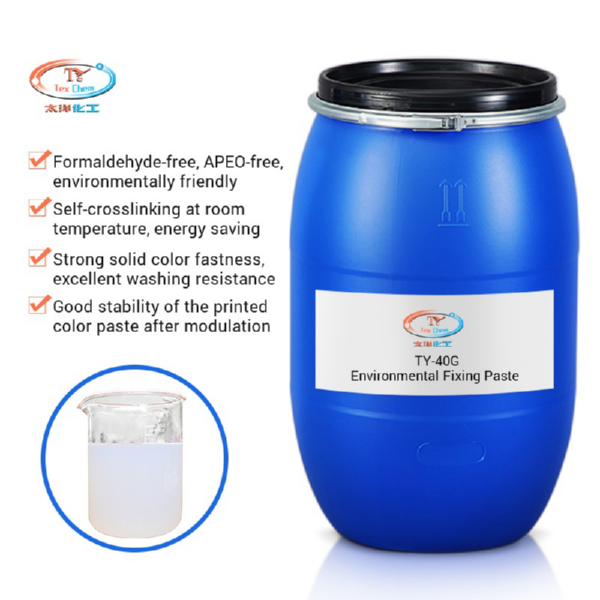
A modern, high-performance solution is our TY-40G Environmental Fixing Paste. This product is a self-crosslinking acrylic copolymer emulsion that acts as a high-strength binder. It's designed to provide excellent fastness while maintaining a soft feel on the fabric, and it's free from harmful substances like formaldehyde and APEO.
If you've ever seen a print with fuzzy, bleeding edges, the problem was likely the viscosity of the print paste. This is where thickeners come in.
Thickeners are used to give the print paste the perfect, honey-like consistency. This prevents the color from spreading uncontrollably into the fabric, ensuring that the printed design has sharp, well-defined edges. The right viscosity is essential for high-quality, detailed prints.
The industry uses both natural (e.g., from seaweed or seeds) and synthetic thickeners. Synthetic thickeners are often preferred in modern pigment printing for their high efficiency, stable viscosity, and ease of use.
For prints that need to withstand the toughest conditions, a cross-linking agent is the key to ultimate durability.
A cross-linking agent is a chemical that, during curing, creates strong chemical bonds between the binder molecules. This transforms the binder film into a tough, three-dimensional polymer network. This network is much more resistant to the mechanical action of washing and rubbing.
While not always necessary for simple prints, a cross-linking agent is essential for high-performance applications like workwear, sportswear, and any item that will be subjected to frequent, harsh laundering.
To meet this need, we offer the 40GA Long-Term Cross-linking Agent. This innovative product significantly improves the resistance to washing and chemicals. A major advantage of 40GA is its stability; when added to an acrylic or polyurethane emulsion, it remains active and won't solidify for over 3 months, offering great flexibility in production.
While binders, thickeners, and cross-linkers are the main players, a complete print paste formula may include other important auxiliaries.
Perfect textile printing is a masterful blend of art and science. The key to that science lies in the intelligent use of printing auxiliaries. By understanding the distinct roles of binders, thickeners, and the cross-linking agent, you can formulate a print paste that delivers on every metric: sharpness, softness, and durability. The right combination is what turns a good print into a great one.
Ready to elevate your printing quality? Explore the complete range of printing auxiliaries from a leading fabric finishing agents factory and find the perfect solution for your needs.
For pigment printing, the binder is unquestionably the most critical component. Without a high-quality binder like TY-40G, the pigment would simply wash off the fabric. It provides the essential adhesion that makes the print permanent.
Can I mix auxiliaries from different chemical suppliers? While it is sometimes possible, it is generally not recommended. Auxiliaries from a single supplier are designed and tested to work together as a system. Mixing products can lead to unforeseen chemical reactions, causing issues like unstable viscosity or poor fastness.
How do I solve the problem of a print feeling too stiff? This is usually related to the binder. To solve it, you can: 1) Choose a binder specifically designed for a soft hand feel, like TY-40G. 2) Add a specialized softener to your print paste. 3) Ensure you are not applying an excessively thick layer of the print paste.
Self-crosslinking means the binder has reactive groups built into its polymer structure. During the curing process, these groups react with each other to form a durable network without the need for an external cross-linking agent. This simplifies the formulation and ensures a high level of durability. To discuss your specific needs, contact our experts today.