


Surfactants are the workhorses of textile surfactant chemistry. They are the active ingredients in everything from scouring agents to emulsifiers and detergents. But not all surfactants are created equal. The choice between the two most common types—anionic vs non-ionic surfactants in textiles—is a fundamental decision that impacts the performance of your entire process. This chemist's guide will break down the differences, pros, and cons of each, helping you formulate more effective textile auxiliaries. For those developing high-performance chemical solutions, understanding these basics is crucial. Explore our range of chemical products to find the right ingredients for your formula.
What is a surfactant? A surfactant (short for "surface-active agent") is a molecule with a unique dual nature. It has two distinct parts that allow it to interface between substances that don't normally mix, like oil and water.
Every surfactant molecule has:
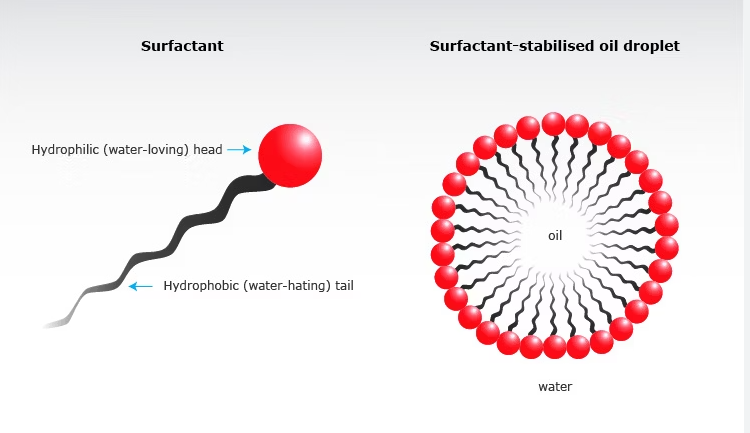
This dual nature enables surfactants to perform four critical actions in textile processing:
Anionic surfactants are the most widely used type in the industry, especially for cleaning applications.
The defining characteristic of an anionic surfactant is that its hydrophilic head carries a negative electrical charge in water. Common examples include sulfates, sulfonates, and carboxylates.
Anionic surfactants are known for their excellent detergency (cleaning power) and their ability to generate a rich, stable foam. This high foaming action is very effective at lifting and carrying away soil.
Because of their superior cleaning ability, they are the primary choice for scouring agents used to remove natural waxes and oils from cotton. They are also the key ingredient in soaps used for after-washing prints and dyes to remove unfixed color.
The main drawback of anionic surfactants is their sensitivity to hard water. The negatively charged head can react with the positive calcium and magnesium ions in hard water, forming an insoluble soap scum. This deactivates the surfactant and reduces its efficiency.
Non-ionic surfactants are the most versatile and second most common type of surfactant used in textile auxiliaries.
As their name implies, non-ionic surfactants have a hydrophilic head that has no electrical charge. This head is typically a long polyethylene glycol chain.
Non-ionic surfactants are exceptional wetting agents and emulsifying agents. Because they lack a charge, they are less prone to creating a dense foam, making them a low foaming choice ideal for use in high-agitation machinery like jet dyeing machines.
Their versatility makes them indispensable. They are used to create stable silicone oil emulsions, as leveling agents to ensure even dyeing, and in low-foam scouring agents for machinery where foam is a problem.
The greatest advantage of non-ionic surfactants is their stability. Because they have no charge, they are unaffected by hard water ions or the high concentrations of salt (electrolytes) often found in a dyebath.
Here is a quick-reference table for the anionic vs non-ionic surfactants in textiles debate:
| Feature | Anionic Surfactants | Non-ionic Surfactants |
|---|---|---|
| Charge | Negative | Neutral |
| Primary Function | Detergency, Foaming | Wetting, Emulsifying |
| Foaming | High | Low to Moderate |
| Hard Water Tolerance | Poor | Excellent |
| Compatibility | Incompatible with Cationics | Compatible with all other types |
In the anionic vs non-ionic surfactants in textiles discussion, there is no single "best" choice. The optimal selection depends entirely on the application. For powerful cleaning where foam is acceptable, anionics are king. For stability in harsh conditions, low foam, and superior wetting and emulsifying, non-ionics are the go-to solution. A professional textile chemicals supplier like Taiyang Chemical can provide both high-quality raw materials and the expertise to help you choose the right one.

Struggling with your formulation? Contact a professional textile chemicals supplier to discuss your surfactant needs with our R&D experts.
What about cationic and amphoteric surfactants? Where do they fit in?
What about cationic and amphoteric surfactants?* Cationic (positively charged) surfactants are primarily used as softeners and anti-static agents. Amphoteric surfactants have both a positive and a negative charge and are specialty chemicals used in gentle detergents or as compatibility aids. Anionics and non-ionics remain the workhorses for most cleaning and processing applications.
Can I mix anionic and non-ionic surfactants in the same formulation?
Can I mix anionic and non-ionic surfactants? Yes, absolutely. Blending these two types is a very common practice in textile surfactant chemistry. A blend can often provide a synergistic effect, combining the powerful detergency of an anionic with the stability and wetting power of a non-ionic to create a superior, all-around product.
What is HLB value and why is it important for non-ionic surfactants?
What is HLB value? The Hydrophile-Lipophile Balance (HLB value) is a scale from 0 to 20 that measures how hydrophilic or lipophilic a *non-ionic surfactant is. This value is critical for selecting the right emulsifier. Surfactants with a low HLB (e.g., 4-6) are good for creating water-in-oil emulsions, while those with a high HLB (e.g., 13-15) are good for creating oil-in-water emulsions.
How does temperature affect the performance of non-ionic surfactants (Cloud Point)?
Non-ionic surfactants have a unique property called a "Cloud Point." This is the temperature at which the surfactant becomes insoluble in water and the solution turns cloudy. Above its cloud point, a non-ionic surfactant loses its effectiveness. This is a critical parameter to consider when formulating products for high-temperature applications like scouring or dyeing. For further technical details, feel free to contact our expert team.